
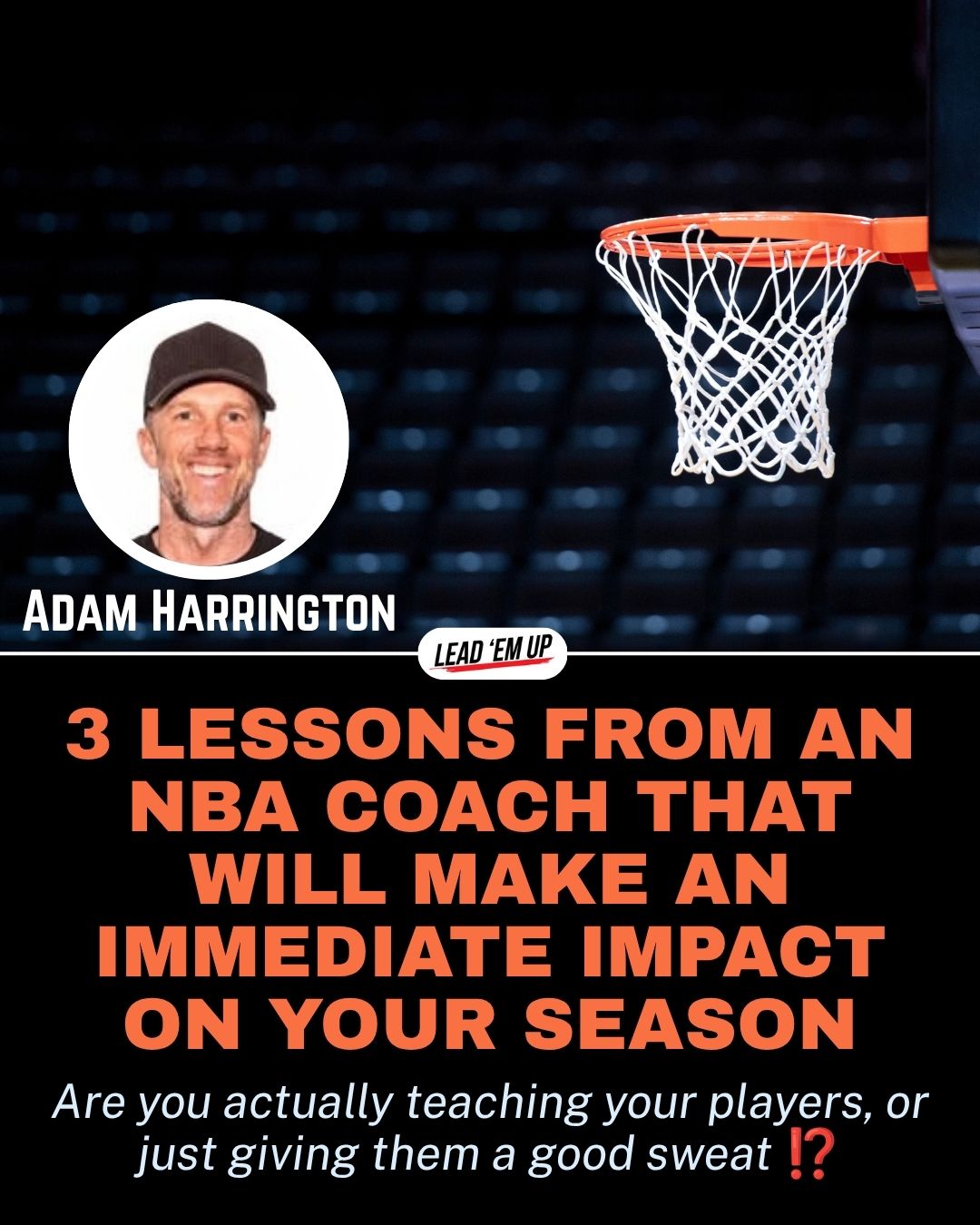
“Nobody cares how much you know until they know how much you care.”
That is the first thing I would tell any young trainer or coach.
I have lived basketball from a lot of different seats. I played professionally and later coached in the NBA. I have spent years training players, from kids picking up a basketball for the first time to some of the best players in the world.
Those rooms look different. The responsibility feels the same.
Players know whether you care about them. They also know when your attention is on what being connected to them can do for you. Care means being honest enough to hold a standard and present enough to help someone reach it. That is where leadership starts for me.
Young coaches ask how to grow and create opportunities. I understand that. Every coach wants a chance to prove what they can do. Your growth begins with how you handle the person and opportunity already in front of you.
These are the three things I would tell any young coach.
1. HONOR THE MOMENT
Honor every opportunity and every person in front of you.
I started with a middle school girl who had never dribbled a basketball. She wanted to make her JV team. That was her goal, and it mattered deeply to her. So it mattered to me.
I treated her like she was Sabrina Ionescu or Elena Delle Donne. Like she was KD or Jimmy Butler. I prepared for her. I paid attention to the details. I gave her everything I had because she trusted me to help her.
The standard was never based on status.
Little did I know that years later I would actually be training those players. Every moment was preparing me for the next one. That first player helped me learn how to watch more closely and communicate more clearly. She gave me the space to hone my craft before anyone knew my name or cared who I worked with.
Social media can make young coaches judge an opportunity by how visible it is. Who is watching? Will this player bring me more exposure?
Do not look past who and what is right in front of you.
There is someone in front of you to honor. There is something in that moment that can make you better. Give that player your full attention and treat their goal like it matters.
Some of the most important work of your career will happen in a quiet gym with nobody watching.
2. BE A TEACHER
I pride myself on being a teacher.
Anyone off the street can tell a player to shoot from a spot and touch a line. A player can do all of that, sweat for sixty minutes and leave with the exact same bad habit they walked in with.
I want to teach while I train.
Young player or pro, I ask myself the same question: What am I adding to them?
Are they seeing something they could not see before? Do they understand why we are working on this and how it connects to the game?
With a young player, the language may need to be simple. With a professional, the detail might be smaller and the conversation may go deeper. The responsibility to teach stays the same.
The best players know when you are filling time. They know when a workout came from a list of drills you give everyone. They also know when you have studied their game and built the work around what they need.
The worst outcome is someone leaving with a great sweat after reinforcing a bad habit for sixty minutes.
Teaching requires you to slow down enough to see what is actually happening. Sometimes you need to stop the workout and ask a question. Sometimes you need to let the player work through a mistake instead of immediately giving them the answer.
Teaching also requires listening. If the player is not receiving the message, find another way to reach them.
Your job is to help the player improve and understand how they are improving. Give them something that stays with them after they leave the gym.
3. BE A CONNECTOR
Connect and share with as many people in this business as you can.
I know what I am good at, and I am still in a constant state of learning and growing. There are incredible coaches and trainers all over the world. I learn from them every year.
Insecurity runs deep in sports, and it runs deep in coaching too. People protect their ideas because they are afraid sharing something will somehow take away from their value.
Fight that.
No one has every answer. Another coach may have one small detail that changes how you teach something for the rest of your career.
Ask the question. When something helps you, pass it on and credit the person who shaped your thinking.
For me, connection means building real relationships. It means being willing to learn from someone and being willing to help them without keeping score. Some of the most important relationships in my life started with a basketball conversation and grew because there was real trust.
When coaches exchange ideas and challenge each other, the players benefit.
We ask our players to be coachable. Coaches have that same responsibility. Stay open and keep learning. Help the people around you grow too.
That middle school girl had no idea she was preparing me for opportunities that would come years later. I did not know where the game would take me either.
What she needed from me was simple. Care about her goal and help her get better.
That was coaching.
It still is.
Encourage Somebody
Have fun and #LeadEmUp


